What are the language implications of the New Silk Road? Will Mandarin be its lingua franca?
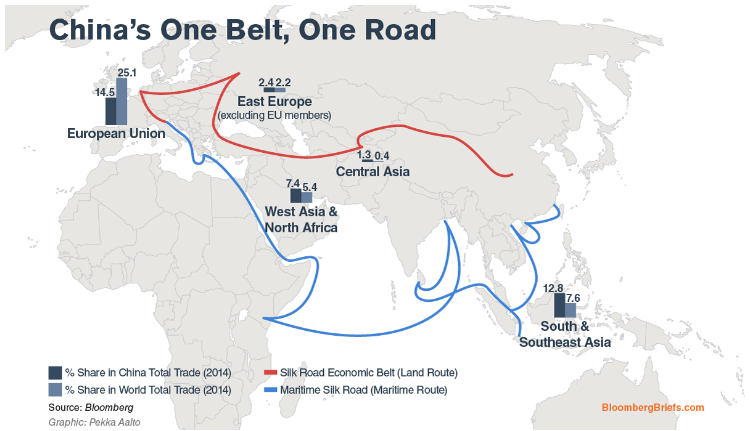
What are the language implications of the New Silk Road? Will Mandarin be its lingua franca?
U.S. citizens are sheep, but sheep get shorn. Another from Dan Sanchez:
https://medium.com/dan-sanchez/humiliation-and-herd-think-52174109511e#.hm8p1kgpl
“Moreover, the troops hold a special place in the fold. They are not sheep, but sheep-dogs, as Chris Kyle was instructed as a boy in American Sniper. Never mind that sheep-dogs work not for the sake of the sheep, but for the sake of the shepherd’s wool and mutton. And when it comes to the humiliation of sheep at the hands of shepherds and sheep-dogs, the herd mind is extremely tolerant.”
From Dan Sanchez:
“Finally Britain had the Saudis give Hussain an offer he couldn’t refuse. Ibn Saud, the Emir of Najd in eastern Arabia, had long been on Britain’s payroll, but had already been largely crushed by the Ottomans before Hussain joined the fight. After the war, Churchill and Lawrence both threatened to unleash Ibn Saud and his fanatic Wahhabi followers against Hijaz if Hussain would not yield. After finally giving up on Hussain ever accepting Sykes-Picot and Balfour, the British made good on their threat and sicced their religiously rabid bulldog on Hussain’s people. As Wahid wrote:
“Ibn Saud’s Wahhabis committed their customary massacres, slaughtering women and children as well as going into mosques and killing traditional Islamic scholars. They captured the holiest place in Islam, Mecca, in mid-October 1924. Sharif Hussain was forced to abdicate and went to exile…”
Ibn Saud, who was willing to play ball with Britain’s colonial designs on the Middle East, thus gained dominion over most of the Arabian Peninsula. As his reward, the British upgraded Ibn Saud’s Emirate to a Kingdom. A British functionary later came up with the name “Saudi Arabia.”
The Saudis midwifed Israel by overthrowing and displacing a major early obstacle to the Zionist project in Palestine. And Zionism midwifed Saudi Arabia when the former’s imperial patron granted the Arabian Peninsula to the House of Saud largely for the sake of Zionism. Israel and Saudi Arabia were born symbiotic twins out of the womb of the British Empire.”
This will sound familiar to those who have read Joseph Campbell:
http://www.reuters.com/article/us-usa-oil-splitters-analysis-idUSKBN0UB08Z20151228
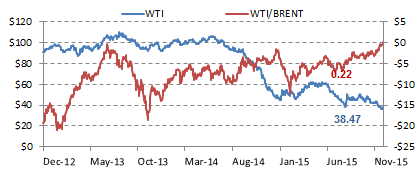
New splitter projects look less attractive as WTI-Brent tightens. This tightening has more to do with the reduced light oil production in the U.S. and less to do with removing the oil export ban. A future oil price rise will incentivize more U.S. shale production, widening the WTI-Brent spread out again, which would make splitters more attractive.
http://www.theimaginativeconservative.org/2015/12/peacenik-prophet-russell-kirk.html
“Kirk saw President Bush’s misuse of Reagan’s Cold War military apparatus as nothing but sheer betrayal of Reaganite, republican, and American principles. In private, Kirk joked that the American people should execute President Bush on the White House lawn. In public, Kirk railed against what he knew to be the beginning of American empire and never-ending war.”
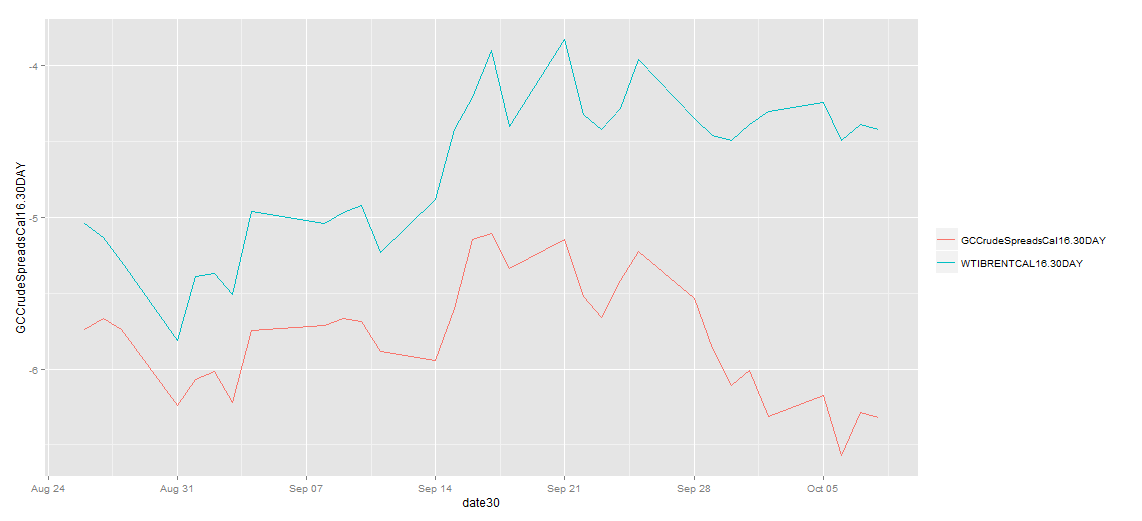
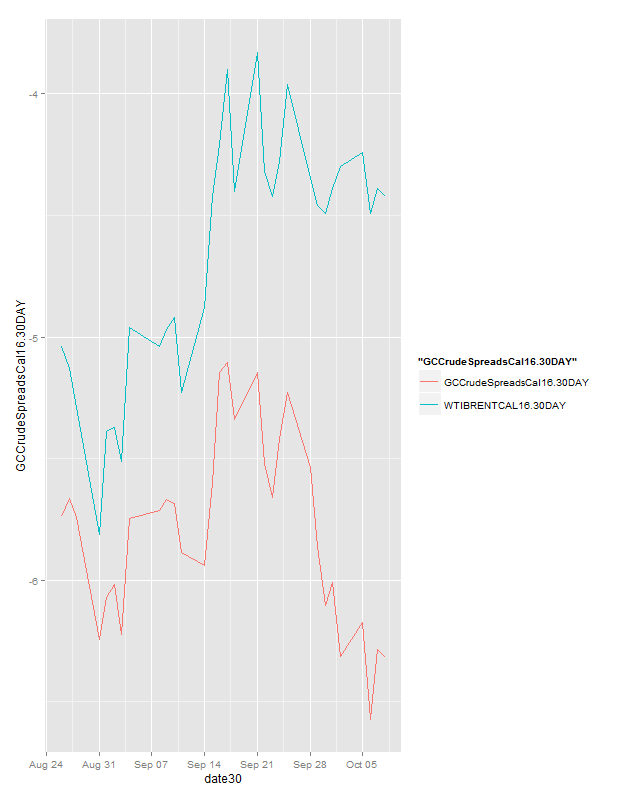 Apparently R does not allow subsetting data by date, creating a dataframes, and then adding a text legend with the grid package. Instead, you can put date, series1, and series2 in one data frame and add each series one at a time to ggplot:
df.total = data.frame(date30,GCCrudeSpreadsCal16.30DAY,WTIBRENTCAL16.30DAY)
port = ggplot(df.total,aes(date30)) + geom_line(aes(y = GCCrudeSpreadsCal16.30DAY,color = “GCCrudeSpreadsCal16.30DAY”)) + geom_line(aes(y = WTIBRENTCAL16.30DAY,color = “WTIBRENTCAL16.30DAY”))
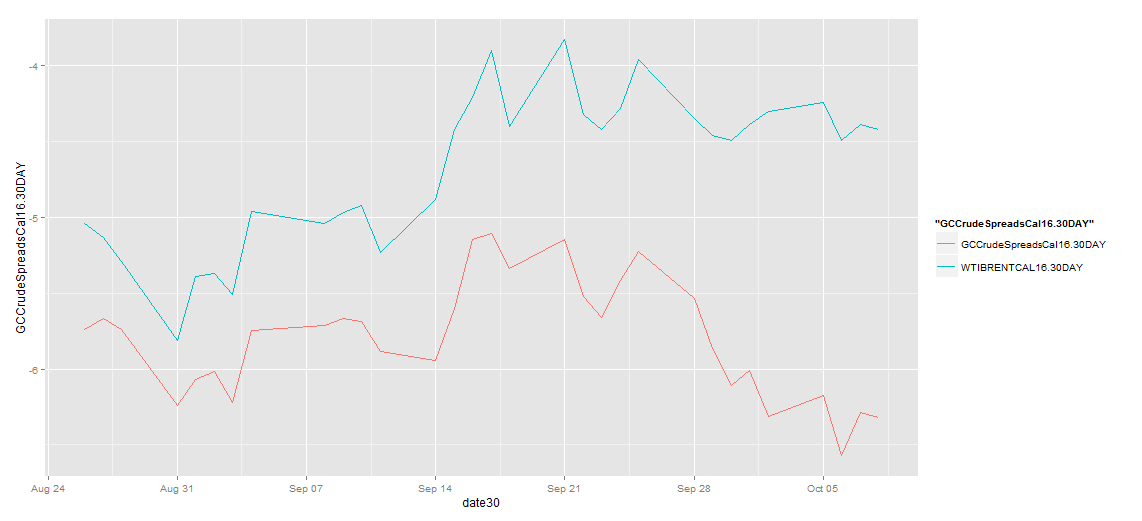
#remove legend title
port + theme(legend.title=element_blank())
Robert Nisbet in The Quest for Community describes the effects of war on a modern, impersonal society composed of disconnected people in search of meaning and purpose.
War brings modern, atomized societies into a temporary sense of community. Empty activities are filled with moral meaning. Everyday life, with its anonymous people repeating meaningless tasks in standardized offices, become part of a common moral crusade. Modern wars are consciously cast as moral endeavors by governments, undertaken for moral abstractions like democracy, freedom, and even women’s rights. The enemy is seen as the personification of evil. War brings a temporary sense of spiritual peace to lives otherwise devoid of moral purpose and disconnected from their fellow citizens. Even shopping for the most meaningless material objects, the symbols of the society which man has striven for and which has made his existence that of a cog in a machine for the production of those objects, takes on a moral significance.
War administration and production for the war effort find their ways into science and education. Psychiatrists forswear their oaths in order to bring evil doers to justice. University researchers turn their attention to making weapons, with the aid of healthy government grants, of course.
After the fighting drags on, and the moral fervor dissipates, the psychological weight of returning to anonymous lives without moral purpose seems heavier than it was before the moral crusade started. What is left is a strengthened government and bureaucratic apparatus devoid of morality, existing for its own sake, more entwined with the productive society, and always on the lookout for new moral crusades for moral cover.
As the war does not turn out as promised, citizens lose faith in their political leaders and turn to the military as the source of national strength and efficiency. If only the politicians had turned the military loose, instead of shackling them, everything would have been different.
Military leaders are increasingly seen as the best of the nation, endowed with almost super-human properties. Soldiers are applauded at airports, and sporting events become constant celebrations of war and the politicians’ tool for waging it, the military. Instead of being seen as at best dupes, and at worst careerists and adventurists with no compunction against killing strangers, soldiers are seen as sacrificing, selfless protectors against an encroaching and ugly world. Minding their business and working for good, they were the victims of sneak attacks by cowards who hate us for who we are, because we are good. The people, despite the lies of politicians and the setbacks in the war of good and evil, have found a new totem, the sacrificial, yet always pure, soldier. For the masses, psychologically there is no choice but dissent into total national self-doubt.
Nisbet ends chapter 2 with a quote for Dostoevsky’s The Brothers Karamozov, from the Grand Inquisitor:
“So long as man remains free he strives for nothing so incessantly and painfully as to find someone to worship. But man seeks to worship what is established beyond dispute, so that all men will agree at once to worship it. For these pitiful creatures are concerned not only to find what one or the other can worship, but find something that all will believe in and worship; what is essential is that all may be together in it. This craving for community of worship is the chief misery of every man individually and of all humanity from the beginning of time.”
Metaphysical yearning is hard to quench. Its pain is ameliorated with communal continuity and symbolism, both religious and social. The continuity assures man of his place in a never-ending cycle, and the symbolism, revered by all in a community, binds that community together. This was the traditional world. It has almost disappeared in the Western world, and has left in its place free-ranging people searching for their place in the modern industrial society, where productive efficiency is valued most highly and which leaves little room for the encumbrances of the old continuities and symbols.
New symbols must be found. Needing something to worship, and needing to know that all others also worship it because the need to live in a community is so strong, the symbols of the managerial State take the place of the old symbols. Those who dare to abstain from worship, or who remain agnostic to these new gods, are despised. Phrases such as “love it or leave it”, or calls for the killing of dissenters become more common. Man must worship something, and when man is cast in a small role in a materialist society where the old ways have been overthrown, and where the democratic lowest common denominator is exalted, the new objects of worship will reflect this.
> library(reshape2)
> library(ggplot2)
> date = data$date
> price1 = data$wti
> price2 = data$ulsd
> df = data.frame(date,price1,price2)
> df2 = melt(data = df,id.vars = "date")
> ggplot(data = df2,aes(x = date,y = value,color = variable)) + geom_line()
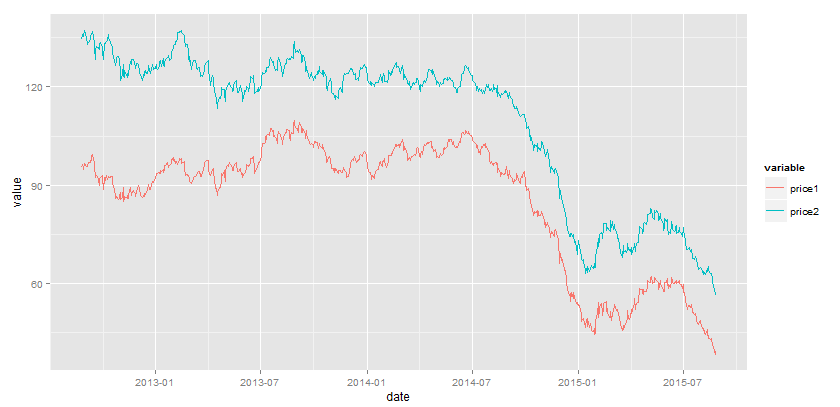
Add ylab and xlab for labels:
> a = ggplot(data = df2,aes(x = date,y = value,color = variable)) + geom_line()
> a + ylab("price")
> library(gridExtra)
> price1 = data$oil
> price2 = data$product
> date = data$date
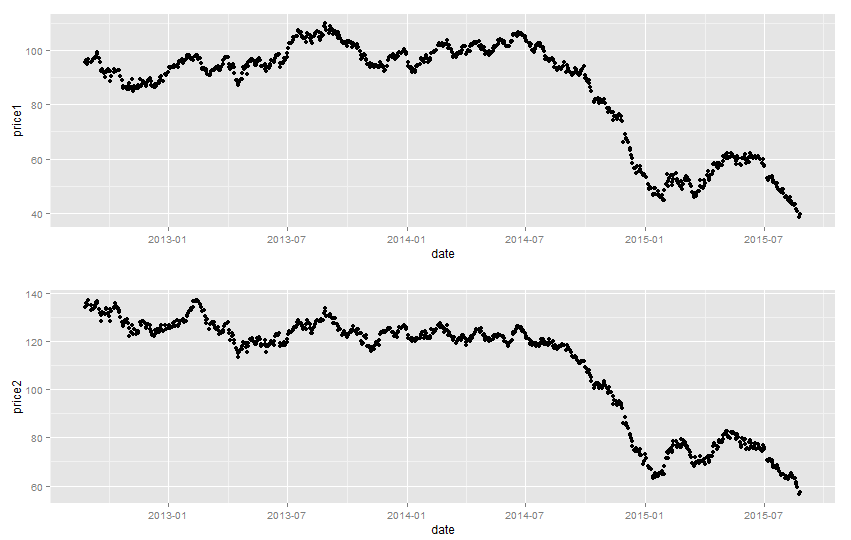
> p1 = qplot(date,price1)
> p2 = qplot(date,price2)
> grid.arrange(p1,p2)