Author Archives: admin

Domestic Politics and Foreign Policy

link to article

From Chuck Spinney:

“An economically weakened, war weary United States is now careening toward a New Cold War with Russia.  But this time, the march of folly is not accompanied by pretentious calls to bipartisanism or even patriotism.  On the contrary, it is clear to the entire world, if not the American people, that the stampede is being driven by the vitriolic excesses of America’s deeply dysfunctional domestic politics.”

From Robert Parry:

“The American mainstream news media has rarely bought in so thoroughly to a U.S.
government propaganda campaign as it has in taking sides in support of the post-coup
government in Ukraine and against Russia and pro-Russian separatists in eastern Ukraine.
Part of this is explained by the longstanding animus toward Russian President Vladimir Putin for
his autocratic style, his shirtless photographs and his government’s opposition to gay rights.
Another part is a hangover from the Cold War when the Russkies were the enemy. In Official
Washington, there is palpable nostalgia for the days of Ronald Reagan’s anticommunist swagger
and “Red Dawn” fantasies.
But another reason for the biased coverage from the U.S. press corps is the recent fusion of the
still-influential neoconservatives with more liberal “responsibility to protect” (R2P) activists who
believe in “humanitarian” military interventions. The modern mainstream U.S. news media is
dominated by these two groups: neocons on the right and R2Pers on the center-left.”


Interest Rates and High Oil Prices

I came across this FT article from several months ago which gives a good picture of where we might be headed in the oil market, as well as in other commodities.  As I described a couple of posts back, the low nominal/negative real interest rates we have been experiencing have incentivized the holding of oil in storage (either in storage tanks or in the ground by not extracting) due to the negative returns available for money which would be received in exchange for the oil.  It has been less expensive to keep the oil in storage than to sell it, especially if one does not have any profitable new business to invest in. 

As rates have flat lined close to zero, oil prices have stayed up in the $95-$100 range since mid-2011.   The forward curve, which was in contango almost continuously from October 2008 until June 2013 (front month minus third month), is now backwardated.  This makes it more expensive for inventory holders to hedge as they have to sell forward to hedge the physical oil they own.  Until June 2013 they were able to capture a hedge profit by selling the higher priced forward and holding it until expiration, when they could buy it back cheaper and roll their hedge forward.  Couple this incentive to hold with the poor alternatives for the cash they would receive from selling their inventories, and the price support becomes obvious. 

Now, however, the forward market for WTI is backwardated and inventory holders must incur a hedge cost when they sell forward at lower prices than spot.  This alone should put downward pressure on spot prices as inventories are sold.  Indeed, inventories at Cushing, Oklahoma continue to decline as oil is sent to the Gulf Coast for either refining or storage.  If refining, this represents demand; if storage, it is just a change in location without affecting the overall level of crude inventories in the US. 

But WTI prices are holding up at around $100.  The normal mechanism would be for the increased supply on the market, induced by a backwardated curve, to push spot prices down until the curve structure is such that holding inventories is cheap enough to slow the selling down.  This hasn’t happened yet.  Is a rate rise what is needed to send prices down to a level more in keeping with what are believed to be supply/demand fundamentals?


Forecasting or Risk Management?

“There’s a chapter in the new book on what I think economics should be about, which is not forecasts. It’s about not taking the wrong risks. You don’t know what’s going to happen but you can avoid excessive risk-taking and this, unfortunately, has not been the policy of the Federal Reserve.”

So says Andrew Smithers in the FT.  He’s right.  The ability to make economic forecasts is highly dubious from both theoretical and empirical viewpoints.  Theoretically, human behavior and interaction is not governed by any stable rules or relationships.  This leads to almost infinite combinations of events, and the possible combinations are always changing.  Empirically, economists are usually wrong in their forecasts.

It is probably a better idea to focus on positioning oneself with the probable current, not try to guess where that current will take you.  In today’s world this usually means trying to understand the likely effects of government, especially central bank, policy on markets.  Free markets with free banking would offer weaker and shorter lived currents.  Better for average people, but worse for speculators.

Unfortunately, reducing one’s goals to simply being on the right side, probabilistically speaking, is not easy.  We are not talking about probability in the sense it is used in the natural sciences.  There are no stable distributions in economics.  Indeed, the most common distribution used in economics and finance, the normal distribution and its offshoots, is based on coin tossing where the probability of each of two possible outcomes is known and stable.  This is not the case when dealing with human beings, whose value scales, tastes, hopes, fears, time preferences, moods, etc. are in constant flux.  This means their reactions to events, which are themselves usually the result of other peoples’ reactions, are unstable from a probability standpoint.  Gambling probability, from which much of financial probability takes its inspiration, deals with large classes of events governed by the same probabilistic laws.  Human behavior, on the other hand, deals with individual cases, each of which has never happened before and which will never happen again, and hence are not governed by any knowable probability distributions.  The a priori distributions we put on them in order to understand them sometimes deviate from the results a posteriori.  This is the danger.

Another quote from Smithers in the article:

 “Prior to the great crash, Ben Bernanke wrote a paper claiming that central bankers have been responsible for what he called the ‘great moderation’. I thought he was right but I thought it was a disaster: in the process of moderating the swings of economies, they were also moderating the perceived riskiness of debt.”

Making economies appear less volatile than they are makes markets riskier.  The price stabilizing policies only serve to mask the true price changes, which makes economic calculation more difficult.  In this case, debt is underpriced in light of the true risk inherent in the economy.  People only see things through a monetary lens.  They see and react to nominal prices, not real prices.  This is when the miscalculation happens.

Volatility and Interest Rates

Volatility is low across many asset classes.  If volatility is a measure of uncertainty, then this is a bit strange.  These seem to be some of the most confusing economic times in recent history, with ever present calls for market crashes while stock markets move up, bonds stay very high, and oil moves sideways.

Central bank policy has provided strength to most markets, as they are designed to do.  This has in effect reduced downside volatility.  Oil is trading at less than 20% implied volatility, well below historic levels, even as economic uncertainty is high.  Oil production in the U.S. is growing and should be putting downward pressure on oil, but prices have been moving sideways since 2011.  Why would $100 WTI, with rising supply and economic crashes always around the corner, be trading at <20% implied put side volatility?

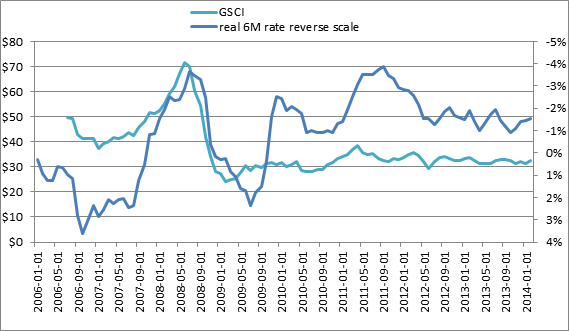
At least part of the answer seems to involve central bank policy.  Low interest rates have sent money out to non-traditional markets in search of yield.  Commodities like oil benefit from this.  Low interest rates also incentivize oil producers to keep oil in the ground.  If their option is to put their proceeds from oil sales into low to negative real rate paying treasuries, then why not wait?  Lastly, the money used by central banks to buy the bonds that keep interest rates low needs a home.  The new money is a wealth transfer from savers to the receivers of the new money, so there is a constant flow of real, not nominal, savings to the bondholders.  They will be looking for somewhere to invest the money.  These three factors, put in place because of the uncertainty the world faces, have led to the paradox of lower volatility in the face of greater uncertainty.

Below is a chart showing the Goldman Sachs commodity index with real 6 month interest rates:

image001


International Investment and Time Preference Mismatching

The mismatch between interest rates and time preferences is well known during times of central bank interest rate manipulation like we have today.  But less understood is the mismatch between time preferences among developed and developing countries.

As societies become wealthier, they begin to have higher savings rates.  The higher savings rates imply a lower time preference, meaning that they are willing to forgo consumption today for greater consumption later.  Time preference is the basis of interest rates.  Lower time preference for consumption leads to greater savings, which leads to more capital available to be lent and lower interest rates.

This all works out because a sufficient amount of capital available for, say, two year loans implies that in two years, when the project for which money is borrowed is completed and its products are being offered for sale, the buying power will be there to purchase the products.  The only question is whether or not the entrepreneur calculated consumer tastes correctly.

But does this work in the world of international capital flows?  Money saved in a wealthy, low time preference country that is invested in a poor, high time preference country could be at risk of a mismatch between the investment and its future products and the ability of the local citizens to purchase those products.  Especially in times like these, when central banks have pushed interest rates to very low levels, and investors are searching for creative ways to earn returns, the danger of mistaking rising foreign asset prices for good investment opportunities due to time preference mismatching seems great.

Interview of Scott Horton, Part 1

Scott Horton is the host of “The Scott Horton Show”, a foreign policy focused radio show from a libertarian point of view.  Scott has done over 2,500 interviews with experts on foreign policy, economics, history and politics since 2003.  They are all available in the archives on his website, scotthorton.org, for free.  I recently talked with Scott in Austin, Texas about U.S. history, foreign policy and libertarianism.

Q:  What is U.S. government foreign policy?

A:  Full spectrum dominance.  The United States government will be the global hegemon and the final arbiter in all disputes which concern them.  They will never allow any nation or group of nations to ever think about challenging their power.  To prolong the unipolar moment indefinitely, where there can never be another Soviet Union that could challenge them.  Peace through domination.

Q:  This doesn’t seem like it has anything to do with the ideas behind the founding of this country.  George Washington’s warnings about foreign relations in his farewell address come to mind.

A:  There are some foundational myths in this country.  The Second World War has in many ways replaced the Revolutionary War as the foundational event of this country.  Our enemies were pure evil, and any means were justified in defeating them.  We emerged from that war as the new British Empire.  We became what we once fought.  And it was justified because we were a force for good, unlike all the previous empires.  We were different.  The rest of the world had been burned to the ground in World War Two, and we were untouched, so we became the world’s factory.  We could afford to be an empire.

Q:  What about economic foundational myths?

A:  The Great Depression.  Every schoolchild learns that Herbert Hoover and laissez faire capitalism caused the Depression.  They tried total freedom and it just did not work.  It doesn’t matter that Hoover really intervened greatly in the economy, and that Roosevelt prolonged the Depression.  What matters is the image of starving people standing in a soup line, and Roosevelt and the New Deal saving the country.  That is much more powerful than the truth.  The message is that without the government, we’d all be in trouble.

Q:  Is war good for the economy?  World War Two, along with the New Deal, got us out of the Depression.

A:  That’s what they say, but it’s not true.  They take GDP from before the war, and compare it to GDP during the war, which is pumped up by military spending that is financed by debt and inflation.  There were shortages of consumer goods.  That GDP increase did not represent an increase in wealth for the citizens of the country.  Robert Higgs has documented this and showed that World War Two was a time of great sacrifice for Americans.  He then showed that it wasn’t until after the war, when the government slashed spending, that the Depression ended.  The destructive experimentation that the New Deal represented was mostly ended, the war ended, the soldiers came home, and the economy was able to grow.

Q:  Is there a connection between central banking and war?

A:  War is very expensive, and the government needs inflation to pay for it.  They can’t raise taxes too much, or the wars would quickly become unpopular.  They can borrow some money from other countries, but that also has its limits.  To really do what they want to do, they must resort to inflation, and central banking allows them to do this.  They just can’t tax and borrow enough.  Printing money is easy.  It’s an accounting trick.  They create debt on one computer screen and create money on another screen and use the money on the second screen to buy the debt on the first.  They can then pay for the war.  The negative consequences come later.  What we saw in the last decade was a false prosperity created by all this new money, especially in the housing market.  So during a time of supposedly great sacrifice, where trillions of dollars are being spent, wasted, on totally non-productive wars, Americans actually have their taxes lowered and feel like the economy is strong.  We even had rebate checks mailed to us.  And then the crash happens and we’re still feeling the effects.  This is all due to the central bank and its inflation.

Q:  How does foreign policy operate in a democracy?

A:  I was taught in school that in a democracy, the policies adopted are more or less what the people want, and there is wisdom in a democratic majority.  The fourth grade narrative is almost as simple as that everything that happens is inevitable.  Did the North really have to militarily invade the South and did 650,000 people really have to die?  Did the U.S. have to have a blind eye turned on Pearl Harbor in 1941 so it could get involved in a European land war?  Did they really have to drop atomic bombs on Japan?  These things are not questioned.  Democracy and majority rule absolves people of questioning what did happen and what may happen next.

Q:  What readings would you recommend to people who want to become more familiar with these issues?

A:  Anyone who wants to understand what’s going on with the U.S. empire should read Chalmers Johnson’s Blowback TrilogyStephen Kinzer has written a lot on Iran policy.  On a more philosophical level, Chapter 14 of Murray Rothbard’s book “For a New Liberty” and his essay “War, Peace and the State” are great.  Read Justin Raimondo to learn about the neoconservatives and what they have done to U.S. foreign policy and what is going on today.

Q:  Are questions of foreign policy, wars, and empire left/right questions?

A:  Both sides are for war and empire and have the same foreign policy goals.  G. Edward Griffin showed me in his book “The Creature from Jekyll Island” that these questions don’t have to be viewed as left/right issues.  You can be a flag waving nationalist, as he is, and see that the world empire is the surest way to bankrupt and bring down America and so be totally anti-war.

Q:  You say you are a libertarian.  What does that mean and how does it affect your foreign policy views?

A:  It means I’m in favor of the non-aggression principle, which says it is never justified to initiate aggression.  I’m against all political relationships that involve coercion.  In foreign policy, I apply the principles of individual morality to governments, which seem to always be exempt from these rules.  The rules shouldn’t change just because the State is doing it.  The government wants to define you as part of a group, and to define which groups you should be against.  But groups are just collections of individuals, each with their own lives and goals, and the usual moral rules should apply.

Q:  Have you always had these views?

A:  I heard George Carlin’s “Jammin’ in New York” when I was about 15.  It begins with his criticism of the first Gulf War and ends with him pointing out the hypocrisies of Earth Day.  School and the media had always told me that I had to be Republican or Democrat, liberal or conservative.  George Carlin handed me a permission slip to not have to choose between them.  I had never heard of libertarianism at the time, but I knew I didn’t want to be on either of those sides.

Capital Flows and Dollar Strength


Overview and Definitions

The value of the dollar should continue its directionless ways, the U.S. economy should maintain low growth, and the Fed should remain accommodative, according to the latest Wells Fargo analysis.

The U.S. current account, the difference between exports and imports of goods, services and transfers, was strengthened in the 1990s by autonomous capital inflows.  Autonomous capital flows are taken in response to current prices, exchange and interest rates, and other economic factors by independent actors.  These inflows strengthened the dollar.  High levels of autonomous inflows seem unlikely as long as the Fed is accommodative, which it will be as long as economic growth and inflation are low.

The dollar’s depreciation was slowed in the last 10 years by accommodating inflows, which are undertaken by central banks for the purpose of settling balance of payments imbalances (the measure of currency flows out of and into a country, where positive means autonomous flows are positive) arising from autonomous flows.  Accommodating inflows usually take place as U.S. Treasury securities purchases, and the sum of autonomous and accommodating flows equals zero by an accounting identity.

Three Dollar Phases

From 1995 to 2002, the trade-weighted value of the dollar rose 40%.  Trade-weighting adjusts currency values based on the extent of their use in international trade.  Gross capital inflows rose more than gross capital outflows as autonomous purchases of U.S. assets increased.  The dollar strengthened from the demand for its use for the purchase of the assets.  The increase in the financial account surplus was offset by the increase in the current account deficit. 

From 2002 to 2008 the dollar declined and was volatile as the financial crisis set in, strengthening from an international flight to safety.  The current account reached 6% of GDP in 2006 as high U.S. demand brought in foreign imports at same time that Western Europe and Japan decreased their imports of U.S. goods as their economies weakened.  Demand for dollars fell and the currency depreciated.

Capital inflows during this period switched from the autonomous purchases of the previous period to accommodating purchases of U.S Treasury securities by foreign central banks.  China in particular heavily intervened to slow the dollar’s depreciation to maintain U.S. imports of Chinese goods.  Autonomous transactions decreased from 70% of gross capital inflows to 40% in 2004 (it would appear that an increase in autonomous inflows is a symptom of, and not necessarily a direct cause, of the relative attractiveness of U.S. assets and hence is not the primary cause of dollar appreciation, though it does contribute in its role in the self-perpetuating process.)

From 2009 to today the dollar has been largely directionless.  The current account is back down to 2002 levels, but autonomous inflows have not picked up.  Accommodating purchases by central banks are nearly double the amount of autonomous purchases of U.S. assets.  As U.S. interest rates have remained low, foreign deposits in American banks have decreased.  This means that foreign holders of dollars are selling dollars and buying other currencies, which weakens the dollar.

Update 7/23:  Foreign investors are buying U.S. Treasuries at the slowest rate since 2006.  Foreign investors, however, include U.S. hedge funds that are legally in the Caribbean.  This will tend to push interest rates higher barring increased Fed purchases.  This is happening at the same time that foreign central banks are decreasing their holdings and the Fed is talking about the possibility of decreasing the QE program.  China, however, has increased its position by 7.8% this year.  It holds $1.32 trillion.  The Fed increased its holdings by 18% to $1.96 trillion.

Bank Profits, the Fed, and Interest Rates

Ignoring the issue of increased interest on loans and higher interest costs for deposits, we’ll focus on the affect a rise in interest rates will have on a bank’s portfolio.

As rates rise, a bank’s assets will roll over into new, higher interest earning assets at different speeds.  The shorter the terms of its assets, the more quickly it will be able to profit from higher rates.  Higher rates will also affect its portfolio of marketable securities (stocks, bonds), with longer term securities decreasing in value more as rates rise.  A bank with high cash reserves, on the other hand, will benefit as it rolls cash into interest earning assets as rates rise.

Bank liabilities are largely made up of CDs, long term borrowing subordinated to deposits, Fed fund borrowings, and retail deposits.  These liabilities become more attractive as rates rise.

Overall, a bank will benefit from a rate increase if it has borrowed long, with locked-in low interest costs, and lent short, allowing it to roll short term, low interest paying loans into higher interest loans as rates rise, funded by its low interest deposits of longer duration.  But how many bank portfolios are structured this way?  The Fed is worried about this.

But, according to Morgan Stanley and as reported by Bob Murphy, the Fed has its own problems. It could have negative equity if an interest rate rise decreases the value of its bond portfolio.  This makes Fed “tapering” very dangerous to its own portfolio and probably unlikely.  It needs to keep interest rates low and its portfolio strong with continuing asset purchases (QE), but those asset purchases continue to skew markets and capital structures and make inflation more likely.  Dangerous territory.


Treason and the Fourth of July

If the men of the Revolution designed to incorporate in the Constitution the absurd ideas of allegiance and treason, which they had once repudiated, against which they had fought, and by which the world had been enslaved, they thereby established for themselves an indisputable claim to the disgust and detestation of all mankind (Lysander Spooner, No Treason, No. 1).

How can a person, by geographic accident of birth, be subjected to the coercion of a group to whom he has given no consent, whether that group is called a gang, a government, or any other name? How can a government, which came into existence through the denial of the historical ties to another government, in turn force its rule on people who have not given their consent? And how is the crime of treason against a government possible where no consent was ever given to that government? These are some of the questions posed by Lysander Spooner in No Treason, written in 1867, a work which is useful in analyzing a current issue, the plight of the government whistleblower.

Lysander Spooner was a lawyer, a radical pro-Constitution abolitionist (his pro-Constitution arguments persuaded Frederick Douglass to drop his disunionist ideas), and a proponent of natural law theory. Spooner argued for jury nullification in fugitive slave cases, and against the idea that slavery was permissible under the Constitution. Spooner believed that government without consent was a form of slavery which differed only in degree with the legal enslavement of blacks as practiced in the country at the time. Because of this, he opposed the Civil War as a violent denial of the right to self government of the Southern states while concurrently arguing for a revolt of slaves against their oppressors.

Natural Law

Natural law, as the foundation of Spooner’s arguments, must be briefly explained and contrasted with its alternatives, broadly speaking. Natural law ascribes to people inviolable rights with which they are born and cannot be rescinded. These are often, and in Spooner’s case are, defined as the ability to live one’s life as one sees fit, without coercion from or obligations to other people, as long as one does not coerce another person. Life, liberty, and the pursuit of happiness are natural law ideas, as is the ability to give or withdraw consent to the rules of any group.

How does a person know that he is born with natural rights under natural law? The very act of defending one’s rights acknowledges their existence. No legal or political sophistry can negate the obviousness of the rights not earned, but defended, by the American colonists against their would-be British oppressors. And no legal or historical theories are necessary to see that the American people today, as most people have done throughout history, through ignorance and laziness, are giving away their natural born rights to a government more oppressive than the British government from which their political forefathers broke.

The Role of the Populace

Governments rarely abstain from expanding their power. Therefore, it is imperative that a people stand for themselves and the maintenance of their own rights against those who wish to take them, who are present in every nation in every time in history. The American people, content with their level of material success, implicitly agree with the government that it is the granter of rights and not the protector. Spooner’s words are true today:

The [government] has thus virtually said to the world: It was all very well to prate of consent, so long as the objects to be accomplished were to liberate ourselves from our connection with England, and also to coax a scattered and jealous people into a great national union; but now that those purposes have been accomplished, and the power of the [government] has become consolidated, it is sufficient for us – as for all governments – simply to say: Our power is our right (No Treason, No. 1).

No constitution, regardless of the legal theories and principles on which it was founded, or the fervor with which it was defended, can withstand the complacency and servility which overtakes a population.

Competing Legal Theories

Utilitarianism, the idea that a law’s worth is measured by the outcome of its implementation, will be, somewhat simplistically, portrayed here as the counter-view to natural law. A common measurement of outcomes is an increase in the aggregate happiness or welfare of a population. A law is said to have positive utility if it increases the welfare of most people, or the total welfare gained is greater than the total welfare lost.

With this brief description it is easy to see that this legal framework is perfectly suited to a government which wishes to increase its power while appearing to act in the people’s interest. In fact, it may actually believe that it is acting for their benefit. The outcome will be the same, since the road to hell is paved with good intentions. So long as people accept the power of a government to legislate their welfare, they are open to having it taken from them, to be dispersed by the government to its favored recipients. The government assumes their consent is given, and uses force to prevent them from withdrawing it. In the government’s view, they were born with their consent handed over.

The Whistleblower and Natural Law

As government power increases, so does the number of people who are willing to expose its actions. Today we have the phenomenon of the whistleblower, the person with inside knowledge of the government’s actions who takes that information and makes it available to the world. In an age of global empire, it is of interest to the people of the world to know what the self-appointed hegemon is doing.

The whistleblower is often accused of breaking the law, and he usually is guilty. He might be guilty of breaking a legitimate contract he has made with his employer, and a penalty could be just. He might also be guilty of committing the act of treason, as defined by the government which has assumed his consent for itself. But that crime does not exist under natural law, which says that consent may be freely given and freely withdrawn. The only real treason is against the truth, and in bowing down to illegitimate authority. Treason is giving consent not to one’s own enslavement, but to the enslavement of his neighbor. There is no treason but that which is against the natural rights of others. The whistleblower may awake these feelings and ignite a re-assertion of natural law.

“Our attachment to no nation upon earth should supplant our attachment to liberty.”
-Thomas Jefferson